Dynamic Strategic Choices
Strategy is a succesive hurdles run, not a single jump


Many years ago, I used to think about Strategy as a journey from a current state to a future, desired destination. The concept of Strategic Destination seemed a solid one.
But time has passed and I have slowly understood that any multi-annual Strategy goes through a sequence of evolutive steps where one set of Strategic Choices that may be valid during the first year of the Strategic Horizon (the timeline for the Strategy journey) mai remain only partially valid, or even be invalid during the following years.
How can this be?
Do we have multiple targets or destinations for our Strategy? Well, yes, but not at the same time. Let me explain.
Why Do We Need a Strategy?
Paying tribute to Richard Rumelt’s Challenges-Based Strategy theory, I would say that we need a Strategy to prepare our organization for encountering a number of Opportunities and Threats that are generally different from those in the past, which turns them into challenges for us. Should we encounter only some that are similar to those that we have been able to surmount in the past … we wouldn’t need a Strategy!
So, our Strategy’s formulation is driven by the challenges of surmounting some future difficult, hard to solve, gnarly problems that may be either Opportunities (new types of positive evolutions that we should profit from) or Threats (new types of negative evolutions that we should defend against). These are our future Problems and the fundamental role of the Strategy is to help us build adequate Solutions for them that should be available to us IN DUE TIME.
Why did I underline “in due time“? Because we will not encounter those future challenges at the same time. If we are lucky, we may focus on preparing only one solution at a time for one next gnarly problem that we are expecting to encounter. But it is also quite likely the they might overlap over time.
The Sequence of Paramount Challenges
Let’s take an example: Michelin, the French Tire Manufacturing company that is well known worldwide. I’ll use the screenshots for their case from the RapidStrategy app.
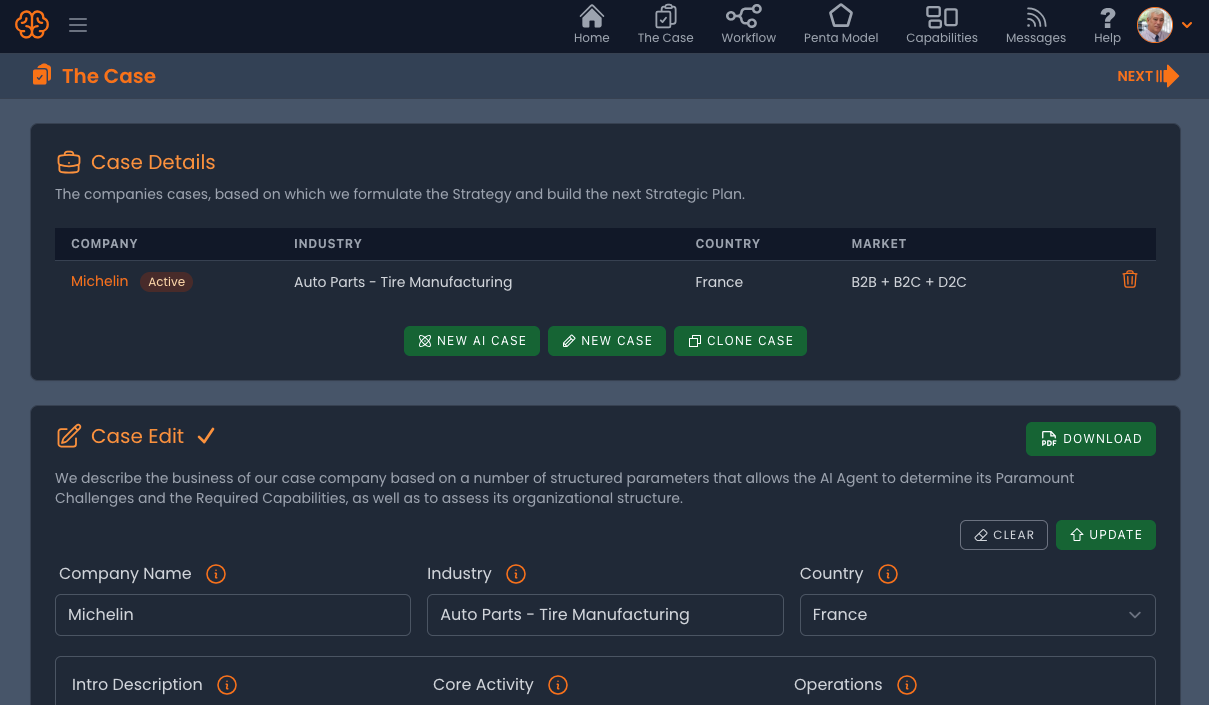
What are the Paramount Challenges that the company will encounter over the following years, what gnarly problems will they have to solve over their Strategic Horizon that has been identified as lasting for this industry until 2028 (3 years)?
Several.
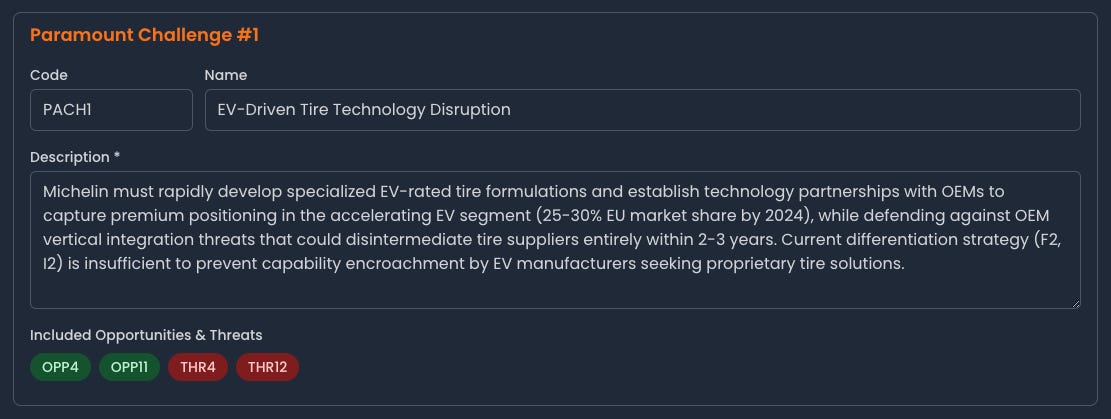
#1 EV-Driven Tire Technology Disruption
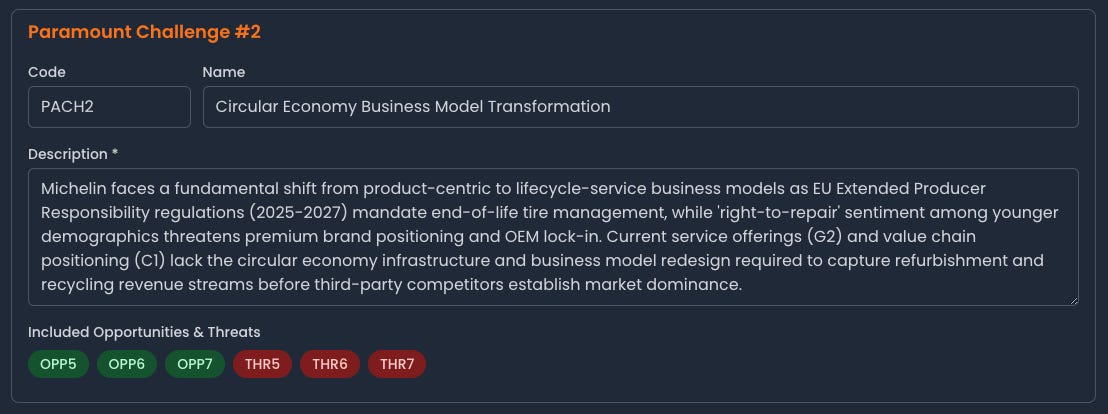
#2 Circular Economy Business Model Transformation
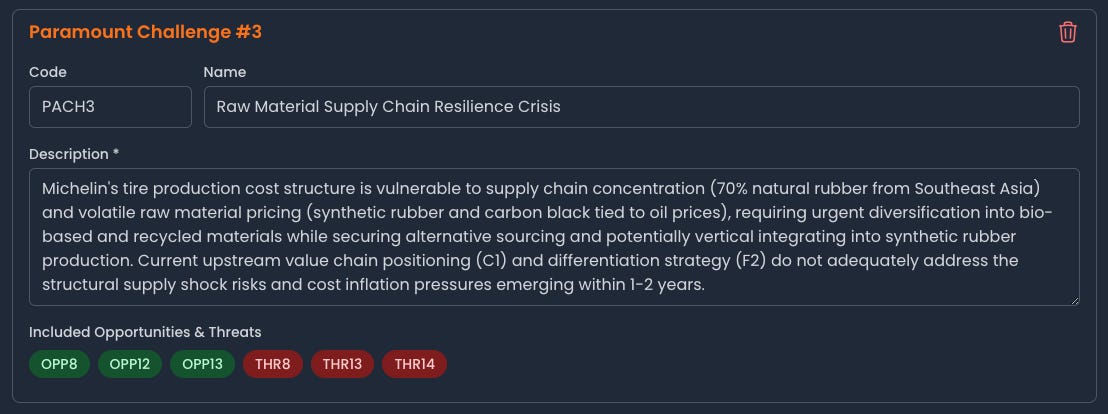
#3 Raw Material Supply Chain Resilience Crisis
#4 Competitive Margin Compression from Multiple Fronts
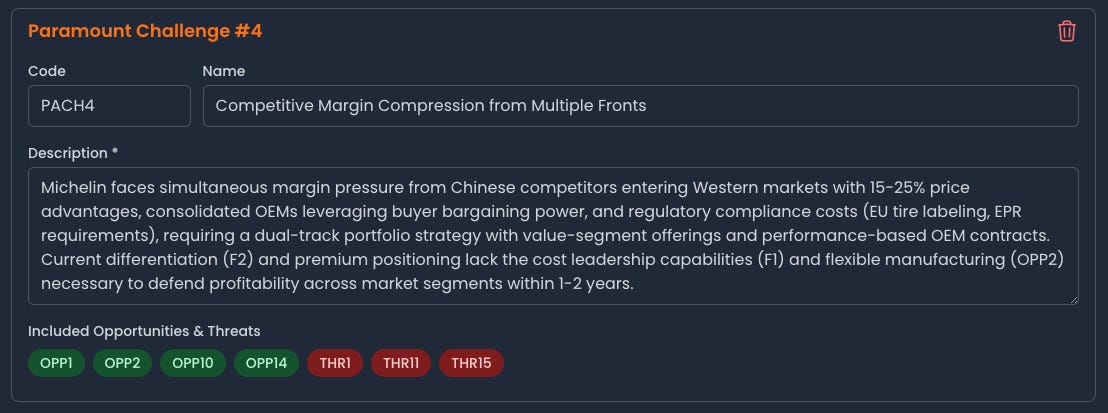
#5 Geographic Supply Chain Fragmentation and Nearshoring
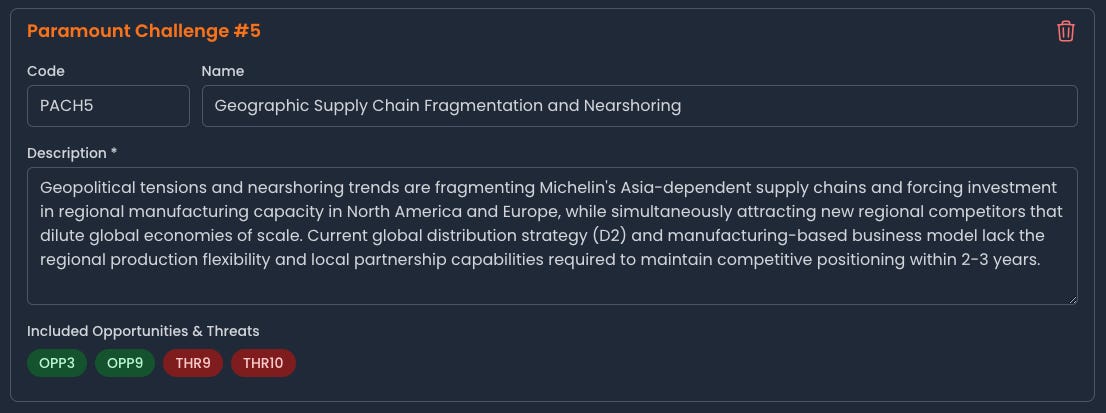
As an observation, the PACH #5 has been spun off from PACH #3, only this year, due to the new geo-political context affecting the international supply chains.
Have you noticed how each Paramount Challenge is incorporating several challenging Opportunities and Threats? What does this mean? The Paramount Challenges are aggregators of discrete problems that may be positive (harvesting the benefits of some new types of opportunities), or negative (being impacted by the consequences of some new types of threats).
The Sequence of Strategic Choices
Again, Strategy is a Solution to a Problem, a future problem (Richard Rumelt). Or a set of solutions for several future problems. In Michelin’s case, there are five of them, and the role of the Strategy is to prepare the solutions for all of them.
Let us clarify one essential thing: For any commercial, for-profit company, the place where the future Paramount Challenges will be encountered and surmounted is the MARKETPLACE. That is where some new Value Propositions, launched into the market as new types of products and/or services must be adequately designed to allow the company to harvest the targeted new types of opportunities and avoid, or be less affected by, the targeted new types of threats.
But the foundation for defining those new Value Propositions, as company’s response to the identified Paramount Challenges, are the STRATEGIC CHOICES.
So, an important next process stage, once those challenges have been identified, is to select the Strategic Choices that will best position the company for building solutions (aka Value Propositions) to the problems (aka Paramount Challenges).
But, as the Paramount Challenges (and their included challenging Opportunities and Threats) are not going to be encountered all at the same time, shouldn’t we have a corresponding sequencing of Strategic Choices that will dynamically mark company’s Strategic Positioning EVOLUTION along the future 3 years of the Strategic Horizon?
If you believe that the answer to this question is Yes, then let us see how would this SEQUENCE OF STRATEGIC CHOICES look like, using the Strategic Choices types of the Penta Model.
Two things to look for in the RapidStrategy app screenshots below:
The Score: Probability on a scale of 1-5 for this to be an adequate Strategic Choice for preparing to encounter this Paramount Challenge
The Solution Narrative: Justification for Strategic Choice’s scoring, anticipating the solution(s) that may be incorporated into the response to the problem(s).
YEAR 1 (2026)
Paramount Challenge #2
Circular Economy Business Model Transformation
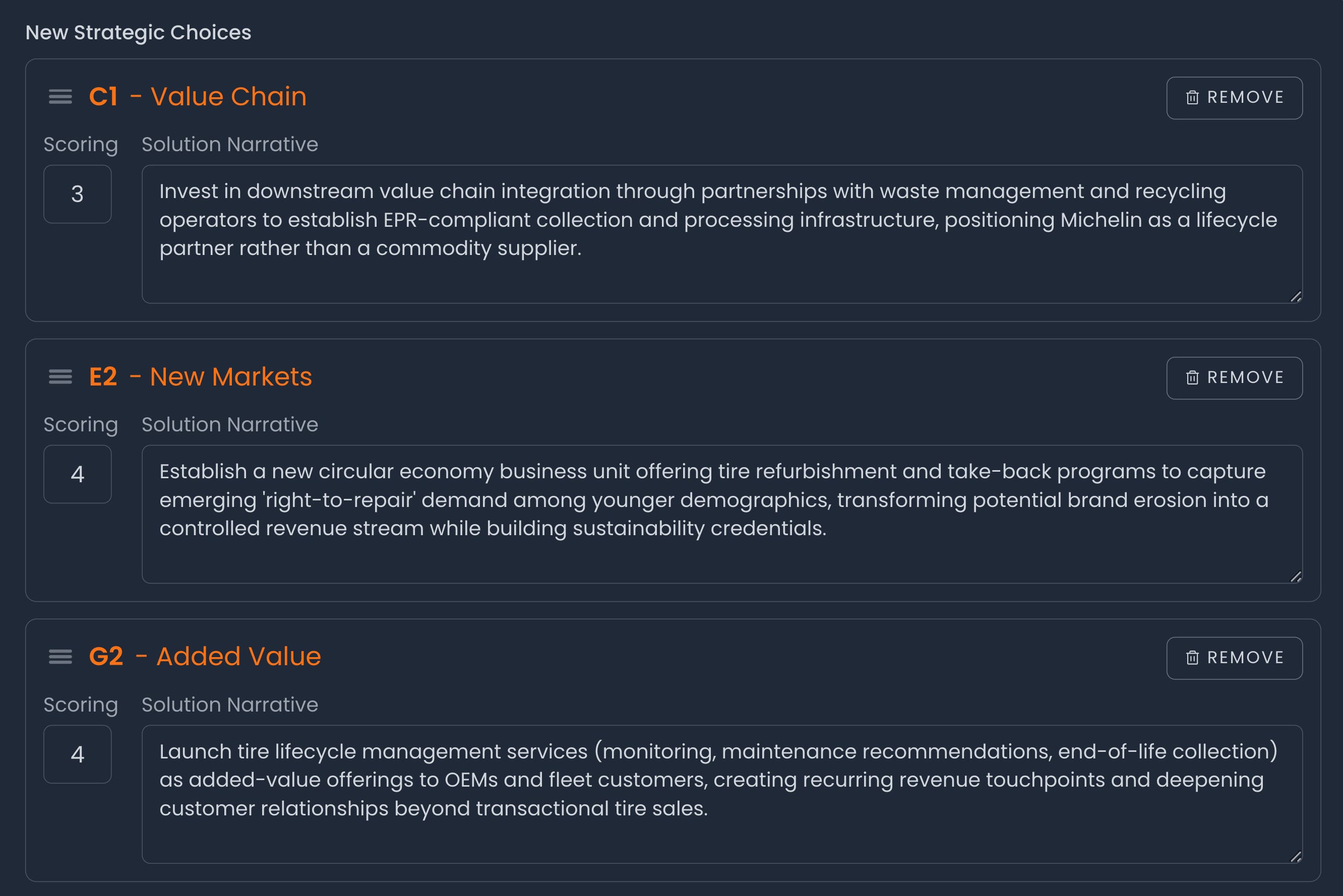
This Paramount Problem is already encountered today. That is why Michelin should build the Value Propositions (and deploy their supporting Required Capabilities) during this year, without delay.
Paramount Challenge #4
Competitive Margin Compression from Multiple Fronts
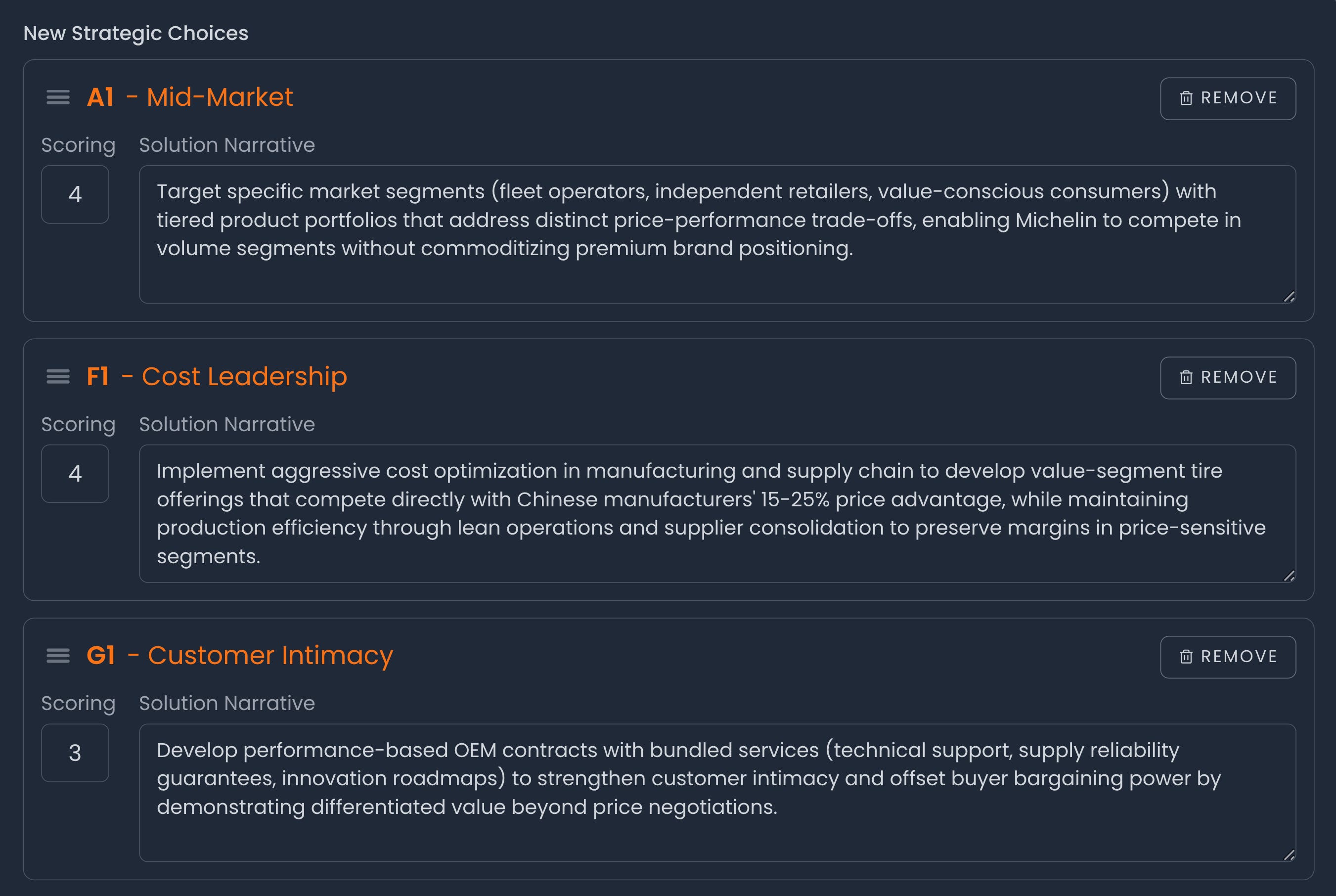
So, Michelin should have their Strategic Positioning in 2026 characterized by these six Strategic Choices that lay the foundation for building the solutions to be incorporated into the Value Propositions to be launched into the market place as this years’s products and/or services portfolio.
YEAR 2 (2027)
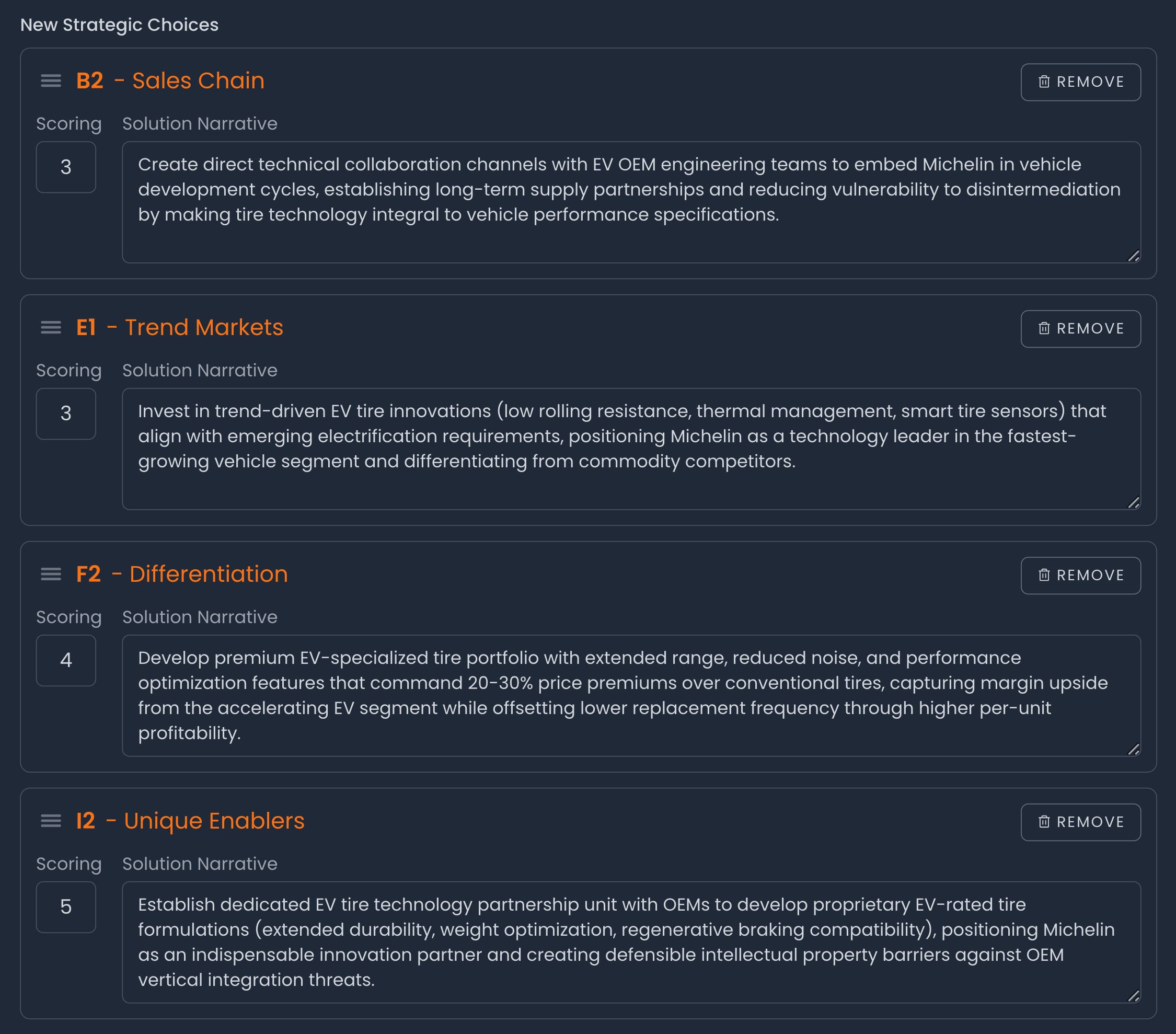
Paramount Challenge #1
EV-Driven Tire Technology Disruption
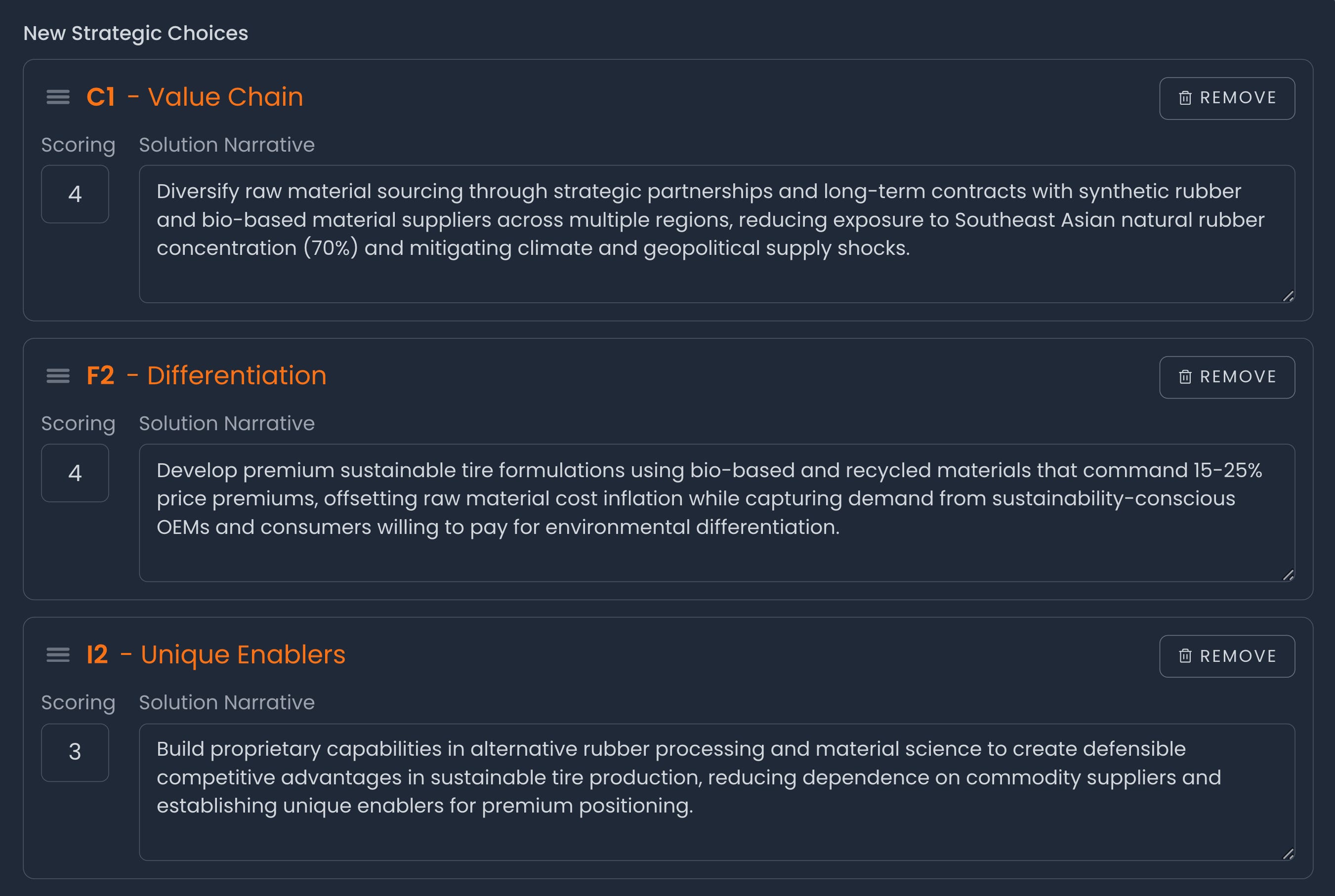
Paramount Challenge #3
Raw Material Supply Chain Resilience Crisis
Paramount Challenge #5
Geographic Supply Chain Fragmentation and Nearshoring
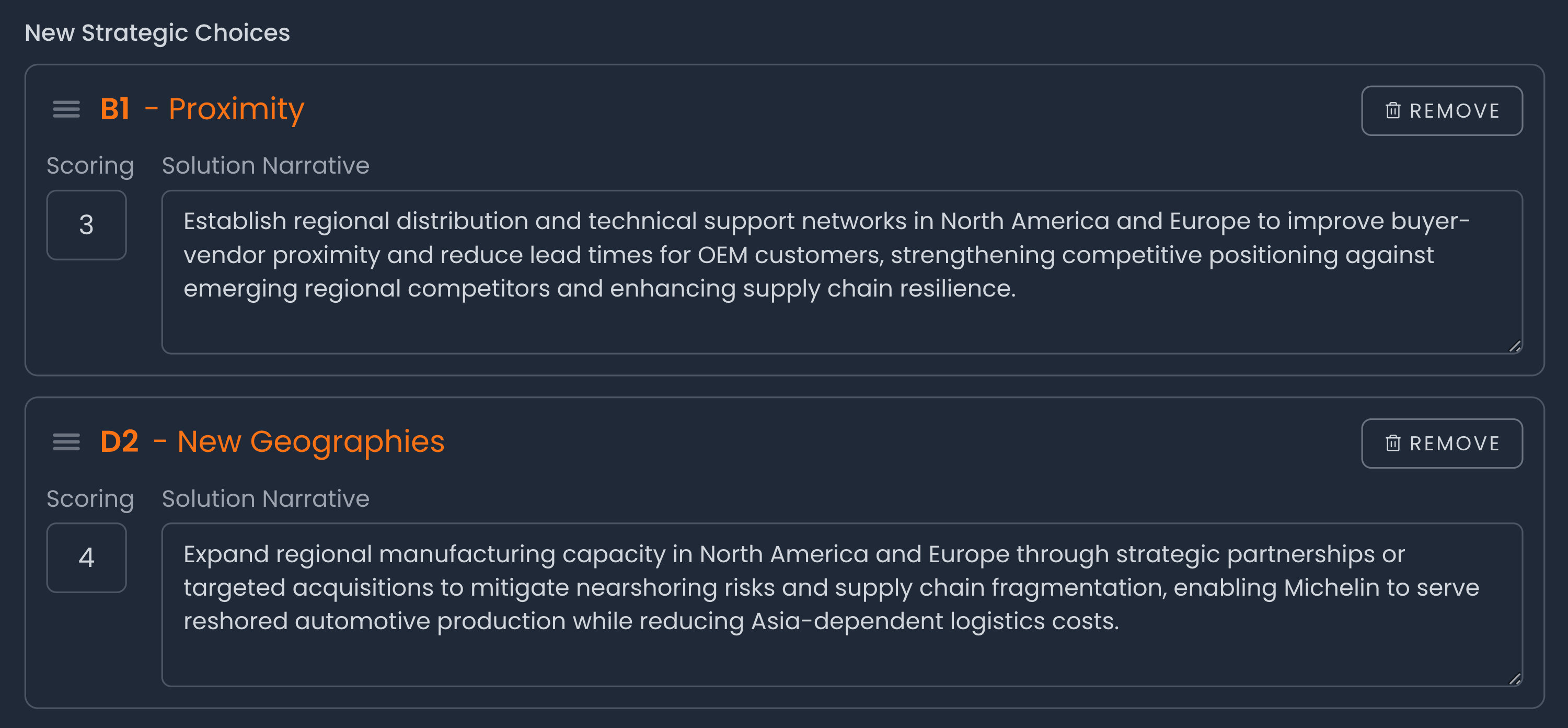
So, the Strategic Positioning of the company will be significantly more complex in 2027, encompassing seven Strategic Choices (of which only one is common with 2026), mainly due to a more complex combination of Paramount Challenges anticipated to be encountered next year.
A BIG QUESTION
Will the five Strategic Choices in 2026 that are distinct from the seven Strategic Choices in 2027 (one being common for both years) be abandoned in 2027?
I bet that you didn’t see this one coming! 😀
Let us find the correct answer, before looking into 2028’s Strategic Choices.
Keep reading with a 7-day free trial
Subscribe to The Strategy Clockwork to keep reading this post and get 7 days of free access to the full post archives.